
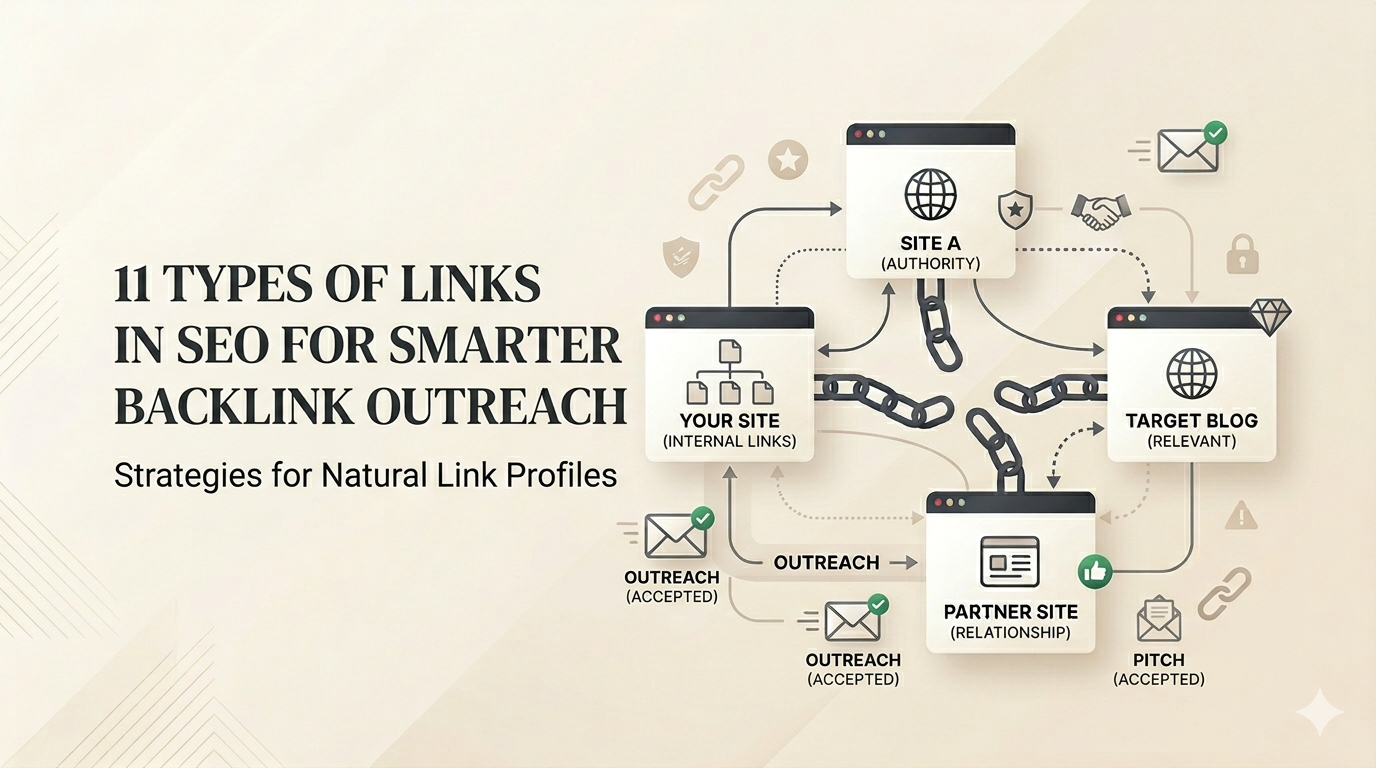
If you think all links in SEO are the same, you are leaving rankings and traffic on the table.
Not all links are equal. Some pass authority, some build trust, and others simply exist without real impact. The difference lies in the type of link and how you use it.
Most guides only talk about backlinks. A few mention dofollow and nofollow. But very few explain how all link types fit together or how they directly impact your outreach success.
That’s where things usually go wrong.
In our experience, many websites struggle not because they aren’t building links, but because they’re building the wrong types of links or using the right ones in the wrong way.
In this guide, you will learn the core types of links in SEO, most effective backlink types in outreach and how to use each type the way.
What Are Links in SEO?
Links in SEO are clickable connections between pages that help search engines discover content, understand relationships, and determine which pages deserve to rank higher.
In simple terms, a link is a bridge.
It connects one page to another either within your own website or across different websites. When someone clicks a link, they move from one piece of content to another.
But for search engines like Google, links do much more than that.
They act as signals of trust, relevance, and authority.
How links work: If many high-quality websites link to a page, search engines assume that page is valuable.
Core Types of Links in SEO You Must Understand First
Before you jump into backlink outreach, you need to understand the foundation of link types.
Core SEO link types include internal links, external links, backlinks, dofollow links, nofollow links, and attribute-based links like sponsored and UGC.
Each one plays a different role. And if you don’t understand how they work, your link-building efforts won’t deliver real results.
1. Internal Links
Internal links connect one page of your website to another page on the same website.
They help search engines:
- Crawl your site faster
- Understand your site structure
- Pass authority between pages
They also help users navigate your content easily.
Pages with strong internal linking often rank faster even with fewer backlinks.
For example, linking a new blog post from your high-authority pages can boost its visibility quickly.
2. External Links (Outbound Links)
External links are links from your website to another website.
Linking to high-quality sources:
- Builds trust with search engines
- Improves content credibility
- Enhances user experience
Many people avoid external links, thinking they “lose SEO value.”
That is a myth.
Linking to relevant, authoritative sources actually strengthens your content.
3. Backlinks (Inbound Links)
Backlinks are links from other websites pointing to your site.
Backlinks are one of the strongest ranking factors. They signal authority, trust and popularity.
In almost every campaign we have worked on:
The pages that rank on page 1 always have better backlinks, not just more content.
4. Dofollow Links
Dofollow links pass SEO value (link juice) from one site to another.
These are the links that directly impact rankings.
When a high-authority site gives you a dofollow link, it’s like a vote of confidence.
Key Point: By default, most links are dofollow unless specified otherwise.
5. Nofollow Links
Nofollow links tell search engines not to pass authority to the linked page.
Do they still matter? Yes, just in a different way.
They help to build a natural link profile, drive referral traffic and create brand signals.
A natural backlink profile always includes a mix of dofollow and nofollow links.
Ignoring nofollow links can actually look unnatural.
6. Sponsored & UGC Links
These are special link attributes that tell search engines the nature of the link.
Sponsored Links
- Used for paid placements
- Attribute: rel=”sponsored”
UGC (User-Generated Content) Links
- Found in comments, forums, etc.
- Attribute: rel=”ugc”
Google uses these attributes to understand link intent and prevent manipulation.
In modern SEO (2026), Transparency matters more than hiding link intent.
Using the correct attributes protects your site from penalties.
| Link Type | Passes Authority | SEO Impact | Use Case |
| Dofollow | Yes | High | Rankings |
| Nofollow | No (direct) | Medium | Natural profile |
| Sponsored | Limited | Low | Paid links |
| UGC | Limited | Low | Forums/comments |
Backlink Types You Can Build Through Outreach
This is where most SEO strategies either win big or completely fail.
Not all backlinks are built the same way. Each type requires a different outreach approach, mindset, and positioning.
In our experience, sending the same outreach email for every link type is one of the biggest mistakes people make.
If you match the right outreach strategy with the right link type, your success rate can easily double.
Let’s break them down:
7. Guest Post Links
Guest post links are backlinks you earn by writing content for another website.
Why They Work
- High control over content and anchor text
- Strong contextual relevance
- Reliable for consistent link building
Don’t pitch links, pitch value.
Instead of saying: “Can I write a guest post?”
Try: “I noticed you haven’t covered [specific topic]. I can create a detailed post with real examples for your audience.”
Tip: Personalized topic pitches get 3–5x more replies than generic outreach.
8. Niche Edit (Contextual) Links
These are links inserted into existing, already-published content.
Why They Work
- Faster results than guest posts
- Already indexed pages
- Strong contextual relevance
Focus on improving their content, not just adding your link.
Example: “I noticed your article mentions [topic], but it’s missing updated data. I recently published a resource that adds value and is happy to share.”
These work best when your content genuinely fills a gap.
9. Editorial Links (Naturally Earned)
Editorial links are earned naturally when someone links to your content without being asked.
Why They are Powerful
- Highest trust signal
- Completely natural
- Loved by Google
You don’t “ask” for these. You earn them by creating:
- Unique data
- Original insights
- Strong opinions
The best editorial links come from content that teaches something new, not recycled ideas.
10. Digital PR Links
These are backlinks from media sites, news platforms, and publications.
Why They Matter
- Massive authority boost
- Brand visibility
- Trust signals
Pitch stories, not links.
Example: “We analyzed 500 websites and found a surprising SEO trend. Would you like exclusive data?”
Journalists don’t care about your link, they care about your story.
11. Resource Page Links
Links from curated pages that list useful tools, guides, or resources.
Why They Work
- Highly relevant
- Easy to scale
- Targeted traffic
Be direct and helpful: “I found your resource page on [topic]. I recently created a guide that could be a useful addition.”
These work best when your content is genuinely useful, not promotional.
12. HARO / Expert Quote Links
Links earned by contributing expert insights to journalists or bloggers.
Why They Matter
- High authority backlinks
- Builds personal brand
- Supports E-E-A-T
Always respond fast, be specific and add unique insight. Short, clear, expert answers get picked more than long explanations.
13. Broken Link Building
You replace a dead link on a website with your relevant content.
Why It Works
- You’re helping the site owner
- Easy value exchange
- Less resistance
Outreach Angle: “I noticed a broken link on your page. I have a similar resource that could replace it.”
This works best when your content closely matches the original link.
14. Image & Infographic Links
Links earned when others use your visuals and credit your source.
Why They Work
- Highly shareable
- Scalable
- Passive link acquisition
Reach out to bloggers, publishers and content creators. Offer your visual as a free resource.
Visual content often earns links faster than text-based content.
Final Talk
If there is one thing to take away from this guide, it is this: SEO success doesn’t come from building more links, it comes from building the right types of links in the right way.
Understanding link types gives you control. And control is what turns random outreach into a predictable growth strategy.
Most websites struggle because they treat all links the same.
But now you know better.
You understand the difference between internal, external, dofollow, and nofollow links, which backlink types actually move rankings and how to match each link with the right outreach strategy.
If you apply the strategies in this guide, you won’t just build backlinks You will build a strong, natural link profile that actually ranks.