
Getting backlinks is hard. Getting replies to your outreach emails is even harder.
Most people send dozens of emails and hear nothing back. No replies. No links. Just silence.
Short answer: backlink outreach emails fail because they are generic, self-focused, and easy to ignore.
In 2026, inboxes are more crowded than ever. Website owners receive outreach emails daily. Most of them look the same. That’s why they get ignored.
But here is the truth…
Backlink outreach is not about asking for links. It’s about offering value in a way that feels relevant and worth replying to.
People don’t reply to emails. They reply to relevance, trust, and value.
In this guide, you will learn how to write backlink outreach emails that actually get replies step by step. No fluff. No outdated tactics.
What Is a Backlink Outreach Email?
A backlink outreach email is a message you send to a website owner, editor, or blogger to request a link to your content usually by offering value in return.
It is not just an email asking for a link. It is a pitch.
You are saying: “Here is something valuable for your content and here’s why it makes sense to link to it.”
Common Types of Backlink Outreach Emails:
- Guest post pitches
- Link insertion (adding your link to existing content)
- Broken link outreach
- Resource page suggestions
Each type works but only if the email feels relevant and useful.
What Makes People Reply to Outreach Emails? (Psychology Explained)
People reply to outreach emails when they feel it is relevant, valuable, and worth their time instantly.
If your email doesn’t trigger at least one of these feelings, it gets ignored.
The 4 Psychological Triggers Behind Replies
In our experience, almost every high-converting outreach email uses at least one of these triggers:
1. Relevance Trigger (This Is About Me)
Before anything else, the reader asks: “Is this email actually for me?”
If your email feels mass-sent, it’s ignored.
Example: “I was reading your guide on technical SEO audits especially the section on crawl budget…”
This instantly tells them: “This is not a random email.”
2. Value Trigger (What Do I Get?)
This is the most important one. People don’t link because you asked. They link because it benefits them.
Types of value that work in 2026:
- Improving their existing content
- Adding missing data or insights
- Fixing outdated or broken links
- Enhancing user experience
3. Trust Trigger (Can I Trust You?)
If the reader doesn’t trust you, they won’t even consider your request.
Ways to build trust quickly:
- Use a real name + real email
- Keep tone natural (not robotic)
- Avoid hype or over-selling
- Mention relevant work (if any)
4. Effort Trigger (Is This Easy to Say Yes To?)
People are busy. If your request feels like work, they will ignore it.
Make it easy:
- Keep emails short
- Be clear about your ask
- Don’t overwhelm with links or info
How to Write a Backlink Outreach Email (Step-by-Step)
A high-converting backlink outreach email has 5 parts:
Subject line → Personalization → Opening → Value → Clear ask
If any one of these is weak, your reply rate drops.
In our experience, most people don’t fail because of effort. They fail because they don’t follow a clear structure.
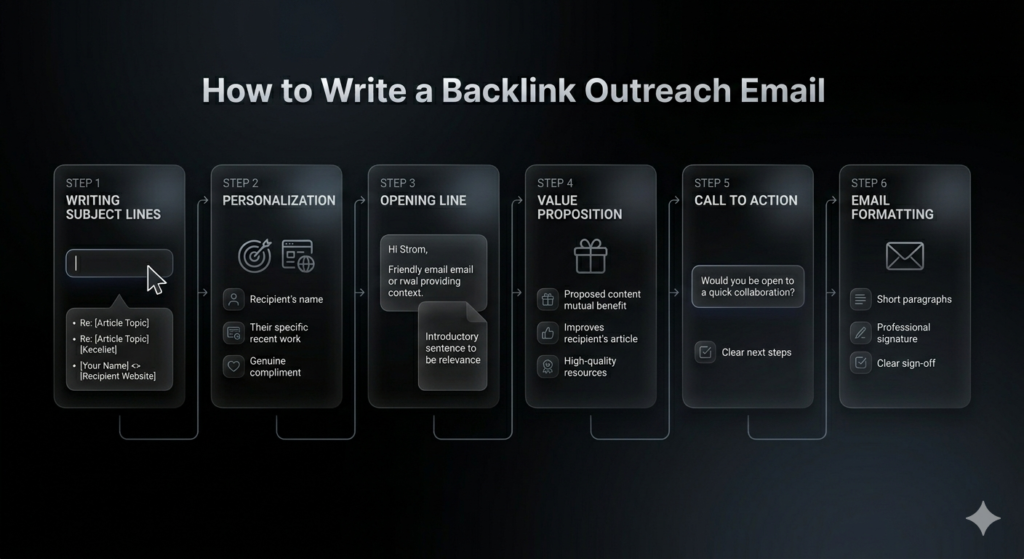
Let’s fix that:
Step 1 – Write a Subject Line That Gets Opened
Your subject line decides everything.
No open = no reply.
What works in 2026:
- Short (3 – 7 words)
- Specific
- Natural (not salesy)
Examples:
- “Quick question about your SEO guide”
- “Suggestion for your article on [topic]”
- “Small update for your post”
Avoid:
- “Link exchange request”
- “Guest post opportunity”
- “Collaboration proposal”
Step 2 – Personalization That Feels Real (Not Fake)
This is where most people go wrong. They either:
- Don’t personalize at all
- Or fake it badly
Mention something specific and relevant.
Good Example:
“I was going through your article on backlink strategies, especially the part about broken link building…”
Bad example:
“I loved your website. Great content!”
This gets ignored instantly.
Step 3 – The Perfect Opening Line
Your opening decides whether they keep reading. Show that your email is Relevant, Personal and Worth attention.
Example:
“I noticed your guide covers outreach strategies, but doesn’t include anything about follow-up sequences.”
Step 4 – Present Your Value (WHY Should They Care?)
This is the most important part. If you mess this up, nothing else matters.
Explain clearly: How your link improves their content
Strong value angles:
- Adds missing information
- Improves depth
- Updates outdated content
- Enhances user experience
Example:
“I recently published a detailed guide on follow-up strategies that could add value to that section and give your readers more practical insights.”
Emails that clearly show content improvement get far better replies than those just asking for links.
Step 5 – The Ask (CTA That Gets Replies)
Don’t overcomplicate this. Keep it Clear, Polite and Easy to respond to.
Examples:
- “Would you be open to adding it as a reference?”
- “Do you think it would fit in your article?”
Avoid being pushy or demanding.
Step 6 – Email Length & Formatting Best Practices
Your email should feel easy to read.
Ideal structure:
- 3 – 6 short lines
- No long paragraphs
- One clear idea
Length guideline:
80 – 150 words works best.
Proven Backlink Outreach Email Templates (2026)
Templates work but only when they are customized with real context and value.
Copy-paste templates fail because they feel robotic. Smart templates work because they give you a structure, not a script.
1. Link Insertion Outreach (Most Effective)
Subject: Quick suggestion for your [article topic]

Hi [Name],

I was reading your article on [topic] — especially the section about [specific point].

I noticed you mentioned [context], but didn’t include anything about [missing angle].

I recently published a guide on [your topic] that covers this in detail and could add value for your readers.

Would you be open to adding it as a reference?

Happy to suggest exactly where it fits.

Thanks,
[Your Name]
2. Guest Post Outreach (Authority Building)
Subject: Content idea for your blog

Hi [Name],

I’ve been following your content on [site name], and your article on [topic] stood out.

I’d love to contribute a guest post.

Here are a few ideas that could fit your audience:

[Topic idea 1]
[Topic idea 2]
[Topic idea 3]

I’ll make sure the content is high-quality, well-researched, and tailored to your readers.

Would you be open to one of these?

Thanks,
[Your Name]
3. Broken Link Outreach (High Conversion)
Subject: Broken link on your page

Hi [Name],

I was going through your page on [topic] and noticed a broken link in the section about [context].

The link to [broken resource] doesn’t seem to work anymore.

I recently created a similar resource on [your topic] that could be a helpful replacement.

Would you like me to send it over?

Best,
[Your Name]
4. Skyscraper Outreach (Content Upgrade Angle)
Subject: Updated resource for your article

Hi [Name],

I came across your article on [topic] and really liked how you covered [specific point].

I noticed it references [old/outdated content].

I recently put together an updated version with more recent data and examples.

It might be a useful addition for your readers.

Would you be open to checking it out?

Thanks,
[Your Name]
5. Resource Page Outreach
Subject: Resource suggestion for your page

Hi [Name],

I was browsing your resource page on [topic], and it’s a great collection.

I wanted to suggest a resource we recently created on [your topic].

It could be a useful addition for your audience.

Would you consider including it?

Thanks,
[Your Name]
Common Backlink Outreach Mistakes (That Kill Reply Rates)
Most outreach fails not because of bad writing but because of avoidable mistakes that instantly turn people off.
Let’s break them down:
1. Sending Generic Emails at Scale
If your email could be sent to anyone… It will get ignored by everyone.
Example: “Hi, I came across your website and loved your content…”
This feels automated.
Make it specific:
- Mention the article
- Reference a section
- Show real context
Even one personalized line can change everything.
2. Asking for a Link Too Early
Many emails jump straight to: “Can you add my link?”
That is a mistake. Because there is no context, no value and feels self-serving.
Build a flow: Show relevance, Highlight value, Then ask
3. No Clear Value Proposition
If your email doesn’t answer: “What’s in it for me?” It will fail.
Weak approach: “I think my article would be helpful…”
Strong approach: “This adds a missing section on [specific topic] and gives your readers more practical insights.”
4. Over-Personalization (Yes, It’s a Thing)
Spending too much time researching one prospect can hurt your efficiency.
Problem:
- You burn time
- You can’t scale outreach
Fix: Use light but meaningful personalization
- One specific reference is enough
- Don’t overdo it
5. Writing Long, Overwhelming Emails
Long emails = low replies. People don’t have time.
Common issue:
- Big paragraphs
- Too many details
- Hard to scan
Fix:
- Keep it short (80 – 150 words)
- Use spacing
- Focus on one idea
Make your email easy to read in seconds.
6. Using Spammy Subject Lines
Your subject line can kill your email before it’s opened.
Avoid:
- “Link exchange request”
- “Guest post opportunity”
- “SEO collaboration”
Use:
- Natural language
- Curiosity-based phrases
- Specific references
Think like a human, not a marketer.
7. Targeting the Wrong Websites
Even a perfect email won’t work if:
- The site is irrelevant
- The content is outdated
- The owner doesn’t care
This is where your internal strategy matters: “analyze website quality before outreach”
8. No Follow-Up Strategy
Most replies come from follow-ups. But people don’t send them.
Reality:
- First email gets ignored
- Second email gets noticed
Fix:
- Send 1 – 2 follow-ups
- Keep them short
- Add value or context
9. Sounding Too Salesy or Pushy
If your email feels like a pitch… It gets rejected.
Example: “This is a great opportunity for collaboration…”
Sounds like marketing.
Fix:
- Keep tone natural
- Write like a human
- Avoid buzzwords
10. Ignoring Email Deliverability
This is a hidden killer. Even great emails fail if they:
- Land in spam
- Go to promotions tab
Best Tools to Help You Write Backlink Outreach Emails (2026)
The best email writing tools help you generate drafts, improve tone, personalize content, and increase reply rates without sounding robotic.
Below are the most useful tools specifically for writing outreach emails:
1. Jasper AI
What it does:
- Generates cold outreach emails
- Creates subject lines and variations
- Helps match tone and style
Why it’s useful:
- Great for first drafts
- Strong for brainstorming angles
- Works well for marketing-style outreach
In our experience, Jasper is best when you already know your strategy and just need speed.
2. Copy.ai
What it does:
- Writes outreach email templates
- Generates multiple variations fast
- Helps with subject lines + CTAs
Why it’s useful:
- Very fast idea generation
- Good for testing different email styles
- Easy for beginners
Best for scaling outreach content quickly.
3. Lavender
What it does:
- Real-time email scoring
- Improves tone and clarity
- Suggests better phrasing while writing
Why it’s powerful:
- Acts like a cold email coach
- Flags weak or spammy sentences
- Improves reply rate structure
In practice, Lavender is one of the best tools for turning “okay emails” into high-performing ones.
4. Mailmeteor
What it does:
- AI email writing inside Gmail
- Personalization from templates
- Quick rewriting and tone adjustment
Why it’s useful:
- Simple and lightweight
- Good for small teams or solo outreach
- Easy integration with Gmail workflow
5. SmartWriter.ai (Bonus for personalization)
What it does:
- Creates hyper-personalized intros
- Uses prospect data (like websites/LinkedIn)
- Writes tailored cold emails at scale
Why it stands out:
- Strong for personalization-heavy outreach
- Reduces manual research time
How to Humanize Backlink Outreach Emails
Humanized outreach emails sound natural, specific, and written for one real person not a list or template.
People ignore emails that feel automated or generic. But they respond when it feels like a real conversation.
Simple ways to humanize your emails:
- Write like you talk: use simple, natural language
- Be specific: mention a real section of their article
- Avoid generic praise: don’t say “great content”
- Add small personal touches: like “I was reading your post today…”
- Keep it short: remove unnecessary lines
Example shift:
Avoid: “I would like to collaborate with you.”
Use: “I had a quick idea that might fit your article.”
Conclusion
Backlink outreach is not about sending more emails. It’s about sending better, more intentional emails that feel relevant, helpful, and easy to respond to.
If you take one thing from this guide, let it be this: People don’t reply because you asked for a backlink. They reply because your email feels useful, specific, and worth their time.
In 2026, inbox competition is higher than ever. Generic outreach no longer works. But the good news is simple:
Small improvements create big results.
If you want better results with backlink outreach, don’t focus on writing “perfect emails.”
Focus on Right people, Right message, Right timing and Right value.
When all four align, replies become natural, not forced.
Now that you understand how to write outreach emails that get replies, the real growth comes from execution:
Start testing different subject lines
Improve your prospect targeting
Refine your follow-up strategy
Because in link building, consistency beats perfection every time.