
Getting backlinks sounds simple.
Send a few emails, ask for a link, and wait… right?
Not really.
In reality, most outreach emails get ignored. Some never even get opened. And many links you do get? They don’t move rankings at all.
Backlink outreach is the process of reaching out to relevant websites and asking them to link to your content. But effective outreach is not just about asking, it’s about offering value.
In simple terms, it’s a mix of research, strategy, and communication.
In our experience, the difference between failed and successful outreach comes down to one thing: quality over volume.
We have seen people send 500+ emails and get nothing. We have also seen campaigns with just 50 highly targeted emails land powerful, high-authority links.
So what is the real difference?
It is not luck. It is the process.
In this guide, you will learn the complete guide about backlink outreach and its process.
What Is Backlink Outreach?
Backlink outreach is the process of contacting website owners, bloggers, or editors and asking them to link to your content.
In simple terms, you’re reaching out to people who run websites and giving them a reason to mention your page.
It usually involves:
- Finding relevant websites in your niche
- Identifying the right person to contact
- Sending a personalized email
- Offering something valuable (not just a request)
Why Is Backlink Outreach Important for SEO?
Backlink outreach helps you earn high-quality links, and those links are one of the strongest ranking factors in SEO.
Search engines use backlinks as signals of trust and authority.
Think of it like this:
- Each backlink = a vote
- High-quality backlink = a strong vote
- Irrelevant or spammy backlink = a weak (or harmful) vote
When multiple trusted websites link to you, it tells search engines: “This content is valuable and worth ranking.”
Not all backlinks are equal.
A single relevant, high-quality link can outperform dozens of low-quality ones.
Why Outreach Is Necessary
A common mistake is thinking: “If my content is good, people will link to it.”
Sometimes that happens but rarely at scale.
The reality is:
- Millions of articles are published every day
- Even great content gets buried
- Website owners don’t know your content exists
That is where outreach comes in. It helps you:
- Get your content in front of the right people
- Earn links faster
- Compete with established websites
Types of Backlink Outreach
Backlink outreach has different types depending on your goal; some focus on guest posting, while others focus on earning links through value, fixes, or relationships.
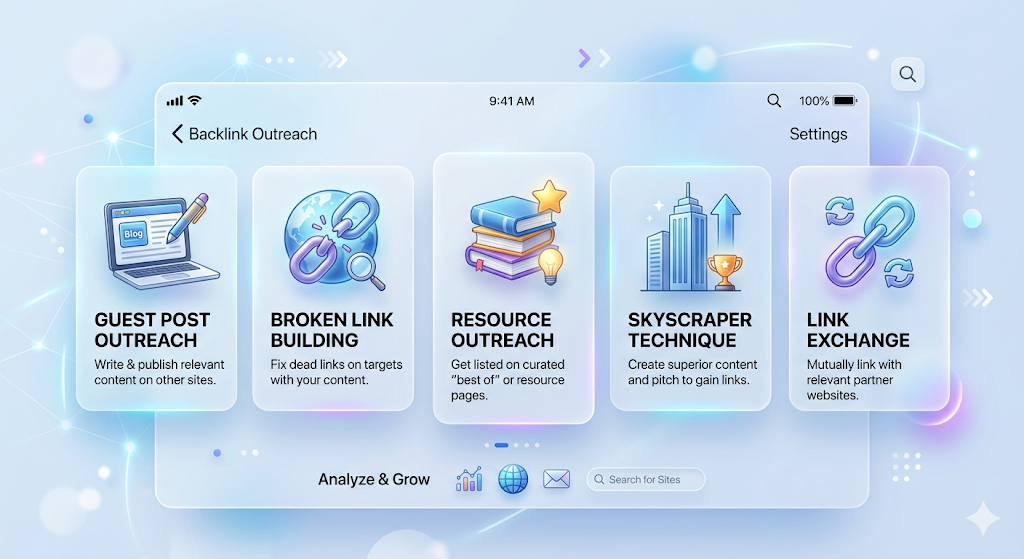
1. Guest Post Outreach
This is the most common type of outreach.
You contact websites and offer to write a guest article for them in exchange for a backlink.
How it works:
- Pitch article ideas
- Write high-quality content
- Get a contextual backlink in the post
Best for building authority and niche relevance.
2. Link Exchange Outreach (Reciprocal Outreach)
Link exchange outreach is when two website owners agree to link to each other’s content for mutual SEO benefit.
How It Works:
- You contact a relevant website owner
- You offer a link from your site in exchange for a link back
- Both sides benefit from increased backlinks
3. Resource Link Outreach
You ask websites to include your content as a helpful resource.
Example: “If you have a resources section, my guide might be useful for your readers.”
Works best when your content is detailed and valuable.
4. Broken Link Outreach
You find broken links on websites and suggest your content as a replacement.
How it works:
- Find dead links on relevant pages
- Inform the site owner
- Offer your content as a fix
High success rate because you’re helping them.
5. Skyscraper Outreach
You improve existing popular content and reach out to sites linking to the original.
How it works:
- Find top-ranking content
- Create something better
- Contact sites linking to the old version
Works well if your content is clearly superior.
6. Mention-Based Outreach
You reach out when someone mentions your brand, topic, or data but hasn’t linked you.
Example: “You mentioned this study here’s the source if you want to link it.”
Easy wins because they already know you.
7. Relationship-Based Outreach
Instead of one-time emails, you build long-term connections.
How it works:
- Engage with bloggers
- Share their content
- Build trust over time
Leads to natural backlinks without constant pitching.
How Does Backlink Outreach Work?
Backlink outreach works by finding relevant websites, pitching them with value, and earning links through personalized communication.
But in reality, successful outreach follows a structured process.
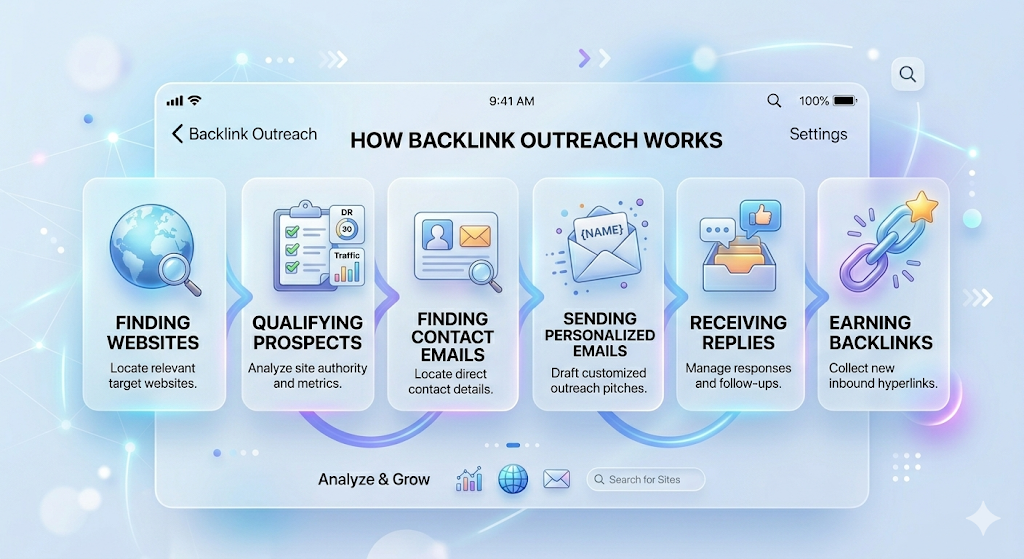
Step 1: Find Relevant Websites
Start by identifying websites that are closely related to your niche.
You’re not looking for any site, you are looking for the right fit.
In our experience, relevance matters more than authority.
Where to find opportunities:
- Google search (your topic + “write for us”)
- Competitor backlink analysis
- Blogs already covering similar topics
Example: If your article is about backlink outreach, target:
- SEO blogs
- Digital marketing websites
- Content marketing platforms
Step 2: Qualify Website Quality
This is where most people fail.
They collect hundreds of websites… but never check if they’re actually worth getting links from.
Here is what we have seen: Unqualified outreach = wasted time + useless backlinks.
What to Check Before Pitching
- Does the site have real organic traffic?
- Is the content relevant to your niche?
- Are articles well-written (not AI spam)?
- Do they link out naturally?
Step 3: Find the Right Contact Person
Sending emails to generic inboxes reduces your chances.
Instead, try to reach:
- The author of the article
- The editor
- The site owner
Where to find contacts:
- Author bio pages
- “Contact Us” page
- LinkedIn or Twitter
- Use tools like Apollo and Hunter.io
Step 4: Craft a Personalized Outreach Email
This is the most critical step.
Most outreach fails because emails feel:
- Generic
- Robotic
- Self-focused
What Works
- Mention their article
- Be specific
- Keep it short
- Offer value first
Example angle:
Instead of: “Please add my link”
Say: “I noticed you covered X. I recently published a guide on Y that adds more depth that might be helpful for your readers.”
Step 5: Follow-Up Strategy
Most links don’t come from the first email.
They come from follow-ups.
What we have seen work best:
- 1st follow-up after 2 – 3 days
- 2nd follow-up after 5 – 7 days
Keep it polite and short.
Step 6: Secure and Track Links
Once your link is placed:
- Check if it is dofollow
- Ensure it’s placed naturally in content
- Track it for future reference
You should also:
- Monitor traffic impact
- Track keyword improvements
How to Identify High-Quality Backlink Opportunities
A high-quality backlink opportunity comes from a relevant website with real traffic, strong content, and natural linking behavior.
You can write perfect emails…
But if the website is low quality, the link won’t help.
In our experience, 80% of outreach success comes from selecting the right websites, not writing better emails.
Key Factors That Define a High-Quality Backlink
Let’s break this down into what actually matters:
1. 🔗 Relevance to Your Niche
This is the #1 ranking factor for backlinks today.
Ask yourself:
- Does this site cover topics related to mine?
- Would a link here make sense to readers?
Example:
- SEO blog: linking to SEO article ✅
- Cooking blog: linking to SEO article ❌
Even a lower authority site can outperform a high DR site if it’s more relevant.
2. 📈 Real Organic Traffic (Not Just Metrics)
Many people rely only on “Domain Authority” or “DR”. That is a mistake.
What we have seen: Some high-DR sites have zero real traffic.
What to check:
- Does the site rank on Google?
- Are blog posts getting traffic?
- Is traffic consistent (not sudden spikes)?
A site with real visitors = more SEO value + referral traffic.
3. ✍️ Content Quality
Look at how the content is written.
Good signs:
- Well-structured articles
- Clear headings
- Useful information
- Human-written tone
Bad signs:
- Generic AI content
- Keyword stuffing
- Thin articles
If the content feels low effort, the backlink likely is too.
4. 🔗 Natural Linking Behavior
Check how the site links out.
Healthy sites:
- Link only when relevant
- Use natural anchor text
- Place links inside content
Spammy sites:
- Link to random industries
- Overuse exact-match anchors
- Stuff links into every paragraph
5. 🧩 Link Placement Potential
Not all backlinks are equal even on the same site.
Best placements:
- Inside the main content
- Contextually relevant section
Weak placements:
- Author bio
- Footer/sidebar
- Random link lists
What Makes a Website Worth Linking To?
A website earns backlinks when it offers something valuable, unique, or hard to replicate.
The Reality Most People Ignore
Many people focus only on getting backlinks.
But they forget one thing: Why would anyone link to you in the first place?
In our experience, outreach becomes 10x easier when your content is actually worth linking to.
The Core Idea: Link-Worthy Content
A website (or page) attracts backlinks when it provides:
- Unique insights
- Useful data
- Better explanations
- Something others don’t have
If your content is just a rewritten version of existing articles… Even the best outreach won’t work consistently.
Backlink Outreach Email Templates That Actually Work
The best outreach emails are short, personalized, and focused on value not on asking for a link.
Template 1: Value-First Outreach (Best for Most Cases)
Hi [Name],

I was reading your article on [Topic] and really liked your point about [specific detail].

I recently published a guide on [Your Topic] where I covered [specific value]. It might be a helpful addition for your readers, especially in the section about [relevant part].

If you think it fits, feel free to check it out.

Either way, great work on the article.

Thanks,
[Your Name]
Template 2: Broken Link Outreach
Hi [Name],

I was going through your article on [Topic] and noticed a broken link in the section about [mention it briefly].

Just thought I would let you know

I also have a resource on [Your Topic] that could be a good replacement if you’re updating that section.

I hope it helps!

Best,
[Your Name]
Template 3: Guest Post Pitch
Hi [Name],

I’ve been following your blog and really enjoyed your content on [Topic].

I’d love to contribute a guest post. Here are a few ideas I think your audience would find useful:
[Topic Idea 1]
[Topic Idea 2]
[Topic Idea 3]

Happy to write something high-quality and tailored to your audience.

Let me know what you think.

Best,
[Your Name]
Tools to Make Backlink Outreach Easier
Using the right tools can save time, increase efficiency, and boost your chances of success in backlink outreach.
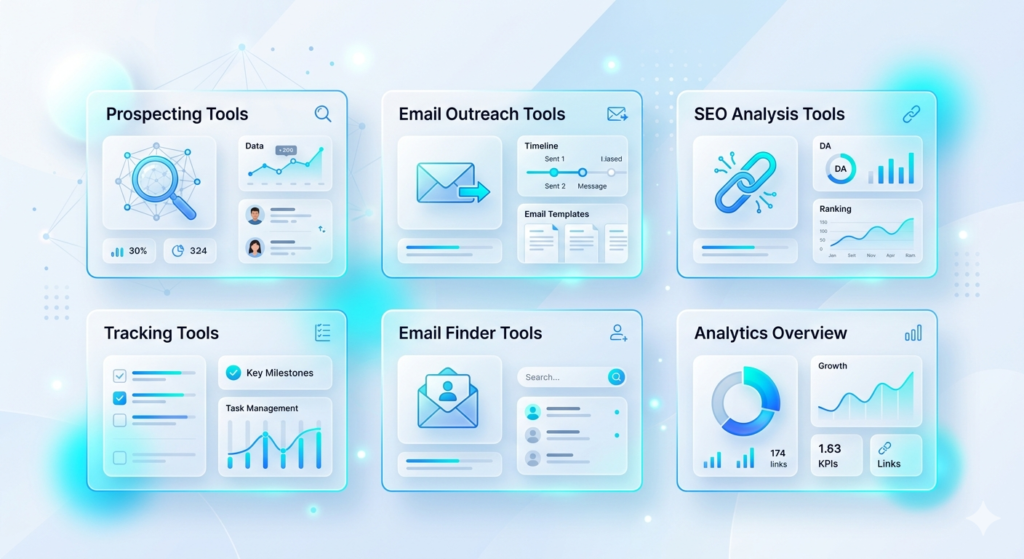
Here are the most useful tools, explained in detail:
Email Finder Tools
1. Hunter.io
Hunter.io helps you find accurate email addresses for website owners or bloggers. You can search by domain and verify emails before sending outreach messages, ensuring your emails reach the right people and reducing bounce rates.
2. Apollo.io
Apollo.io is an advanced platform that combines email search with CRM features. You can find leads, organize contacts, and manage your outreach campaigns from one dashboard, making large-scale backlink outreach easier.
3. Voila Norbert
Voila Norbert is a fast and reliable tool to look up email addresses for your outreach targets. Its simple interface and verification system ensure that your emails are delivered, which is crucial for building meaningful backlinks.
SEO Tools to Identify Backlink Opportunities
4. Ahrefs
Ahrefs is an SEO powerhouse for backlink outreach. You can analyze competitor backlinks, discover high-authority sites in your niche, and identify potential outreach targets. It’s essential for finding quality link opportunities and improving your SEO strategy.
5. SEMrush
SEMrush helps you research backlink prospects and monitor your website’s link profile. With its tools, you can track competitor backlinks, find relevant sites to reach out to, and analyze the effectiveness of your outreach campaigns.
6. Moz Link Explorer
Moz Link Explorer allows you to check domain authority and find potential link sources. By analyzing competitors’ backlinks and industry-related sites, you can prioritize outreach to high-value domains that will improve your SEO.
Outreach & CRM Tools
7. Google Sheets / Notion
Google Sheets or Notion are simple but powerful tools for tracking your outreach campaigns. You can organize contacts, record email attempts, and follow up systematically, ensuring nothing falls through the cracks.
8. Pitchbox
Pitchbox automates your outreach sequences and follow-ups. You can manage large campaigns, personalize emails at scale, and monitor replies, saving time while increasing your success rate.
9. Email Tracker Extension
Email Tracker extensions help you know when recipients open your emails. By tracking opens and clicks, you can follow up strategically, improving response rates and maximizing the impact of your backlink outreach.
Content & Template Tools
10. Canva
Canva helps you create visually appealing content, infographics, or images that can make your outreach more compelling. Sharing well-designed visuals increases the likelihood that website owners will link back to your content.
11. Grammarly
Grammarly ensures your outreach emails are clear, professional, and error-free. Polished emails create a good impression, improve response rates, and help you maintain credibility when requesting backlinks.
By using these tools effectively, you can streamline your backlink outreach process, reach the right contacts, and build high-quality backlinks that strengthen both local and global SEO efforts.
Common Mistakes in Backlink Outreach
Even with the best strategies and tools, many outreach campaigns fail because of simple mistakes. Avoiding these pitfalls can significantly improve your success rate:
1. Sending Generic Emails
Mass emails that aren’t personalized often get ignored. Always research the recipient and tailor your message to show relevance and value.
2. Targeting Irrelevant Websites
Reaching out to sites unrelated to your niche can hurt your SEO and waste time. Focus on websites that align with your content and audience, whether local or global.
3. Ignoring Follow-Ups
Not following up is a missed opportunity. A polite reminder after 3 – 5 days can dramatically increase response rates.
4. Focusing on Quantity Over Quality
It’s better to secure a few high-quality backlinks than hundreds of low-value ones. Target authoritative sites with engaged audiences for maximum SEO impact.
5. Overlooking Email Clarity and Grammar
Emails with spelling mistakes, poor formatting, or unclear messaging reduce trust and credibility. Tools like Grammarly can help ensure your outreach is professional.
By avoiding these mistakes, you can improve your backlink outreach results, build stronger relationships, and secure high-quality links that boost both local and global SEO.
Measuring Success of Your Backlink Outreach
Tracking the results of your backlink outreach is essential to know what works and where to improve. By monitoring key metrics, you can optimize your strategy and maximize SEO impact.
1. Number of Replies
The first indicator of outreach success is the number of responses you receive. Personalized, relevant emails usually get higher reply rates, showing your approach is effective.
2. Links Acquired
Measure the actual backlinks you earn from your outreach. Focus on quality over quantity links from authoritative and relevant sites have the greatest SEO value.
3. Domain Authority of Linking Sites
High-authority sites contribute more to your SEO than low-authority ones. Tools like Ahrefs, SEMrush, and Moz can help evaluate the strength of the domains linking to you.
4. Traffic from Backlinks
Backlinks don’t just boost rankings, they can also drive direct traffic. Monitor referral traffic in Google Analytics to see which links bring engaged visitors.
5. Campaign Optimization
Use these metrics to refine your outreach strategy:
- Adjust your email templates for better replies.
- Target higher-authority sites for maximum impact.
- Follow up strategically with contacts who haven’t responded.
By consistently tracking these metrics, you can improve your backlink outreach, build stronger relationships, and achieve better SEO results locally and globally.
Final Thoughts
Backlink outreach is not just about sending emails and asking for links.
It is a structured process that combines research, relevance, personalization, and value-driven communication.
In simple terms, if your outreach feels spammy or random, it will fail. But if it feels helpful and targeted, it can consistently earn high-quality backlinks.
At the end of the day, backlink outreach is not a shortcut. It is a long-term SEO strategy that builds authority, trust, and rankings over time.
If you focus on quality over quantity, and value over requests, you’ll not only earn better links, you will build a stronger foundation for your entire website.